


We don’t talk enough about the thrill that comes from making correct predictions in marketing. A lot of what we do is really just gambling, hoping we get it right.
In my years managing social media for brands, nothing’s hit quite like going viral or inventing a meme trope before it spread everywhere else. It felt like touching the sun (and why we burn out the way we do, that’s for another time!)
But now I’m more interested in touching grass. Touching grass—being grounded in the real world with real people—is critical to do our work well. We need to understand what people actually want, not just what will capture the already chronically online’s attention.

Beyond all the AI revolution headlines, I’ve been squinting, trying to see what the future holds for marketing professionals. And this one thought kept popping up: For the first time, marketers need to think about persuading not just human intelligence, but artificial ones too. These AI assistants are getting baked into everything—from your phone to your fridge. So how do we market to them? And more importantly, which product and service categories need to care about this sooner?
I wanted answers. And that brought us to the doorstep of our inaugural Ask Gen Pop survey.
We surveyed 200 gen pop consumers who actively use AI tools—because if AI shopping is happening, it’s happening with them first. Our focus was on the everyday American, not tech early adopters or industry insiders, to understand how real people are actually integrating AI into their purchasing decisions. Our questions probed their entire shopping journey: what categories they’re using AI for, where they draw boundaries, and critically, what makes them trust (or distrust) AI recommendations.
The goal was simple: find the patterns in behavior before they become obvious, so we marketers know where to lean in versus where to back off.
First, the headlines:
AI has become the new personal shopper for 85% of respondents, with nearly 1/3 now bypassing search engines entirely when starting their product research.
Women are adopting AI for shopping faster than men, but they use it differently —women use it to browse and discover, while men research with a strong intent to purchase.
People love AI for comparing prices and finding thoughtful gifts, but draw a hard line at letting it make purchases or choose anything that expresses their identity.
Cars, homes, clothing, and anything over $100 are mostly considered high-stakes, and people are not likely to automate purchases in these categories anytime soon.
Now the numbers
85% of respondents use AI for shopping
31% start their shopping search in AI platforms (mostly ChatGPT) instead of Google search
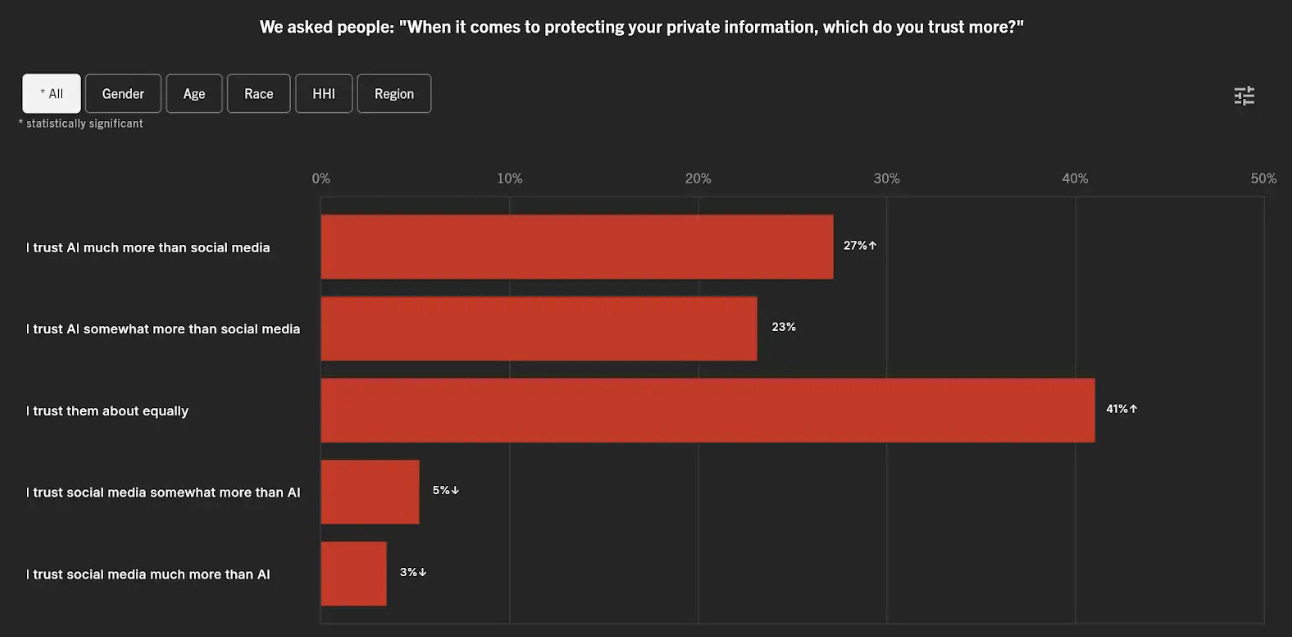
50% trust AI more than social media for purchase research
74% mostly trust AI recommendations (but purchases over $100 still require human validation)
Pricing, deal-finding, and gift-giving are the top AI use cases.
Gen pop uses AI to save money and cut down on time spent researching.
People are using AI to comparison shop across retailers without having to open 17 tabs. Women are adopting AI faster than men, but men appear to be much closer to making a purchase by the time they use AI for research. One gamer in the survey told us:
“I just had to search for the [gaming] consoles, and the AI brought up the information for me and conveniently organized the pros and cons. I could read them within a couple of minutes, and it made it a lot easier to see the key details for the features that I wanted and the prices.”
This person reminds me of how my husband shops—and I suspect he’s not the only one who’s used to toiling over reviews, Reddit replies, and Wirecutter roundups to make informed purchases. For people like him and our gamer, AI is the assistant that just hands him an executive summary for every purchase.
Everyone wants to be a thoughtful gifter.
A reassuring finding was that people aren’t only using AI to take shortcuts—they’re using it to be more thoughtful. Beneath the pursuit of efficiency, there’s a desire to show up for those we care about.
People shared that these were the moments where AI stepped in to curate meaningful gift guides:
Son-in-laws, husbands, teens, and nieces/nephews, and those with niche interests
Age-appropriate gifts, particularly children
Creative alternatives beyond the “basics” or when “running out of ideas”
They’re asking: “What should I get my dad who loves BBQ?” or “What’s cool for a 14-year-old gamer right now?”One parent put it perfectly:
“I’ve got a four-year-old son who is really into superheroes...and I sometimes exhaust buying him just the little Hulk plastic figurines. I would use AI to explore other types of toys that use the same likeness, the same character.”
As an aunt, I know how easy it is to over index on gift-giving in an effort to show a child you care about their interests and want to be remembered. And as a parent, I know how quickly toys take over your house; how easy it is to buy your way through every parenting challenge. AI isn’t a shortcut here. It’s an imagination partner that takes the stress out of showing you care without adding to your clutter.
The trust threshold is real: AI is great to compare, but not to commit.
People will let AI recommend, research, and compare—but absolutely won’t let it click “buy” on their behalf.
Discovery? Great. Research? Done. Check out? Hell no.
Several shopping categories are off-limits:
The overwhelming consensus on cars is that people want to test drive them, see them in person, and feel how they handle before buying.
Clothing and a sense of style are too personal because they reflect your identity. People prefer to organically cultivate their style rather than have AI synthesize trends to guide them.
Within healthcare and medicine, people want comprehensive care with human practitioners involved—they do not fully trust medications, supplements, and guidance from AI.
Groceries and produce should also remain AI-free because people don’t trust that it can identify freshness, ripeness, and quality.
Intimate items like underwear, personal care, sexual health products should also remain personal.
Jewelry and emotional pieces like engagement rings will lose their meaning if AI is involved.
Homes are too significant, nuanced, and unique to be solved by AI.
And finally, anything over $100-200 is financially significant and would likely need a friend or family to back up the recommendation.
Some of this surprised me. For example: I do want grocery shopping automated—most of us aren’t that great at picking fruits anyway. I’m in my thirties, I already have a personal style, and I’d love for AI to find more of what I love in my price point. And sure, I want to test drive and make the final call, but car shopping is overwhelming and I want AI to narrow it down for me.
My takeaway: People aren’t willing to outsource self-expression—emotional, identity-driven categories remain mostly human territory.
Nobody trusts AI for subscriptions.
Despite this seeming like an obvious use case, people say AI “is not smart enough.” Here, I disagree. Or at least, see a future for improvement.
People are increasingly averse to predatory subscriptions and in general, want control over where their money goes. And right now, subscriptions are more daunting than helpful. People are overwhelmed by dog food and diapers piling up at their doorstep. Those reminder emails to cancel your auto-restock? Easily ignored as spam.
But what if AI could predict when you’re running low on toilet paper and gently suggest adding it to your cart—instead of auto-charging you? OpenAI has an opportunity to solve this with their recent Pulse feature.
There are clear gender differences in search behavior.
Women use AI for discovery—browsing, exploring, window shopping. Men use AI for consideration—researching and comparing with the intent to buy. As a marketer thinking about the funnel, this distinction matters.
So what’s the future of AI marketing? It’s about narrowing down the infinity of the internet into something hyper-curated and actually relevant. In the end, we are delightfully left with more questions for our next survey.
What should the next survey theme be? Reply or message me with any thoughts; we’re eager to uncover more for marketers and curious minds.
cannot wait to see where this goes! gift giving via AI was not on my bucket list — but it's actually great to know as I'm advising my clients on how to approach their holiday plans.